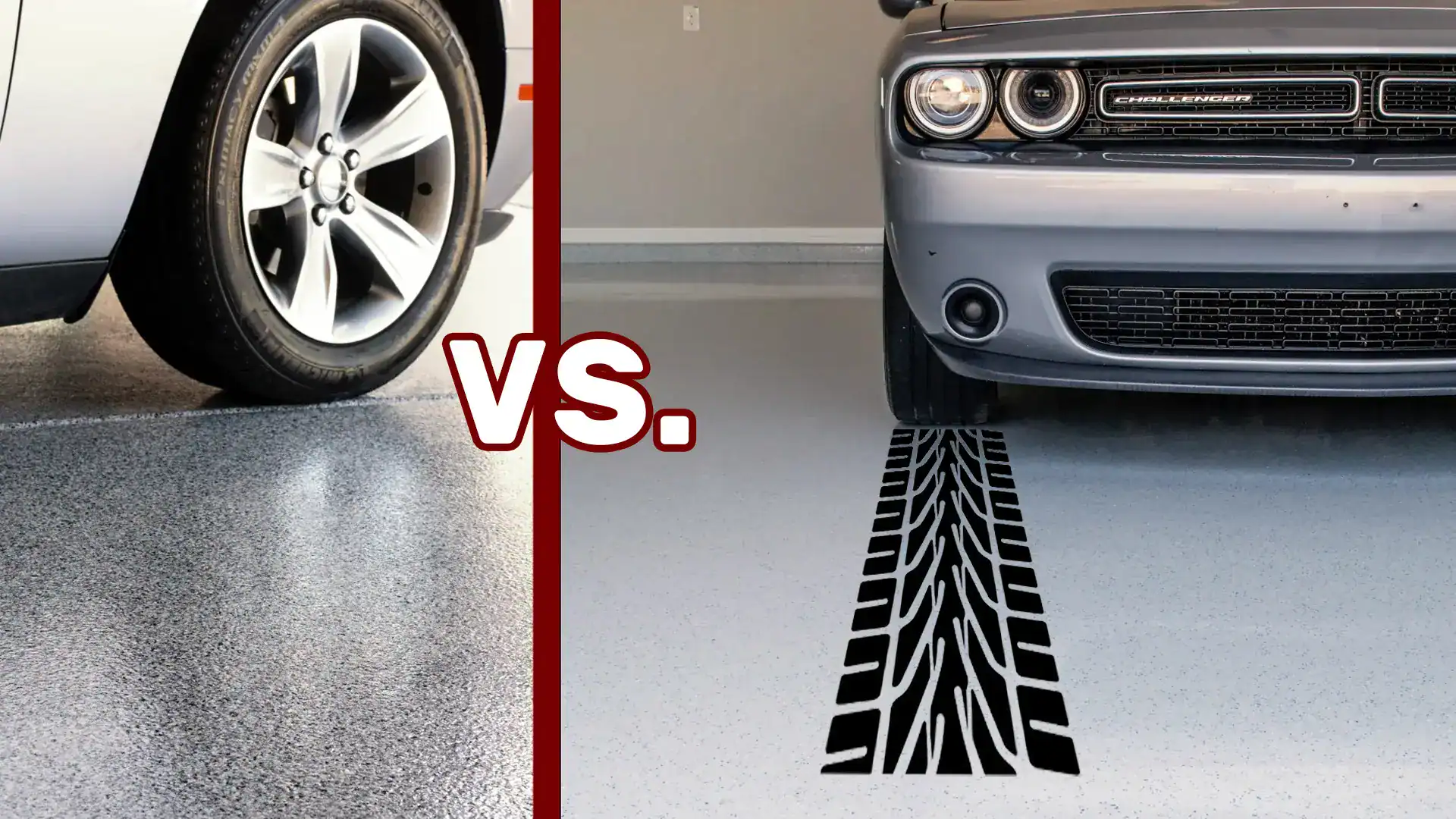
Your garage floor might look perfect right now. Smooth, clean, and ready for daily use. But every time you park your car, your coating is being tested. Hot tire transfer is one of the leading causes of early coating failure. A professionally installed polyaspartic floor coating is built to withstand it, but only when the system is designed correctly.
What Happens Every Time Your Tires Hit the Floor
Many “1-day” garage floor coatings rely on thin, quick-cure polyurea-polyaspartic coatings as both: (1) the direct-to-concrete primer coat (bad idea as these coatings are poor moisture vapor barriers), and (2) the single, clear top coat. They offer fast installation, but it’s really speed over quality.
Regarding the clear top, even this can be an issue if the polyaspartic is of lesser quality (i.e., low-density cross-linking, as is often the case with 1:1 mix ratio polyaspartics, and less-than-100%-solids). Here’s why.
Car tires contain plasticizers that keep rubber flexible. As tires heat up during driving, these compounds migrate to the tire’s surface. When parked, the plasticizers migrate from the tires into the garage floor coating below. Over time, this causes staining, surface softening, and eventual adhesion breakdown.
Hot tire transfer is not just cosmetic. It is often the first sign the coating system is failing.
Why Fast Systems Fall Short
Without a quality, high cross-linking, 100%-solids polyaspartic as the clear top coat, hot tire transfer is not uncommon. It’s easy to determine the quality of the coating system, and specifically the quality of the polyurea-polyaspartic used, by simply looking at the “Warranty Exclusions” section of the bidding documentation provided by the installer.
If you see that either “moisture-related issues” or hot tire transfer (aka “plasticizer migration”) are not covered by the warranty, seek out another installer! (Note: Some “1-day” installers even suggest parking the car on vehicle pads! If this is their solution, why bother spending the money on a garage floor coating at all).
How a 2-Day Polyaspartic Floor Coating System Holds Up
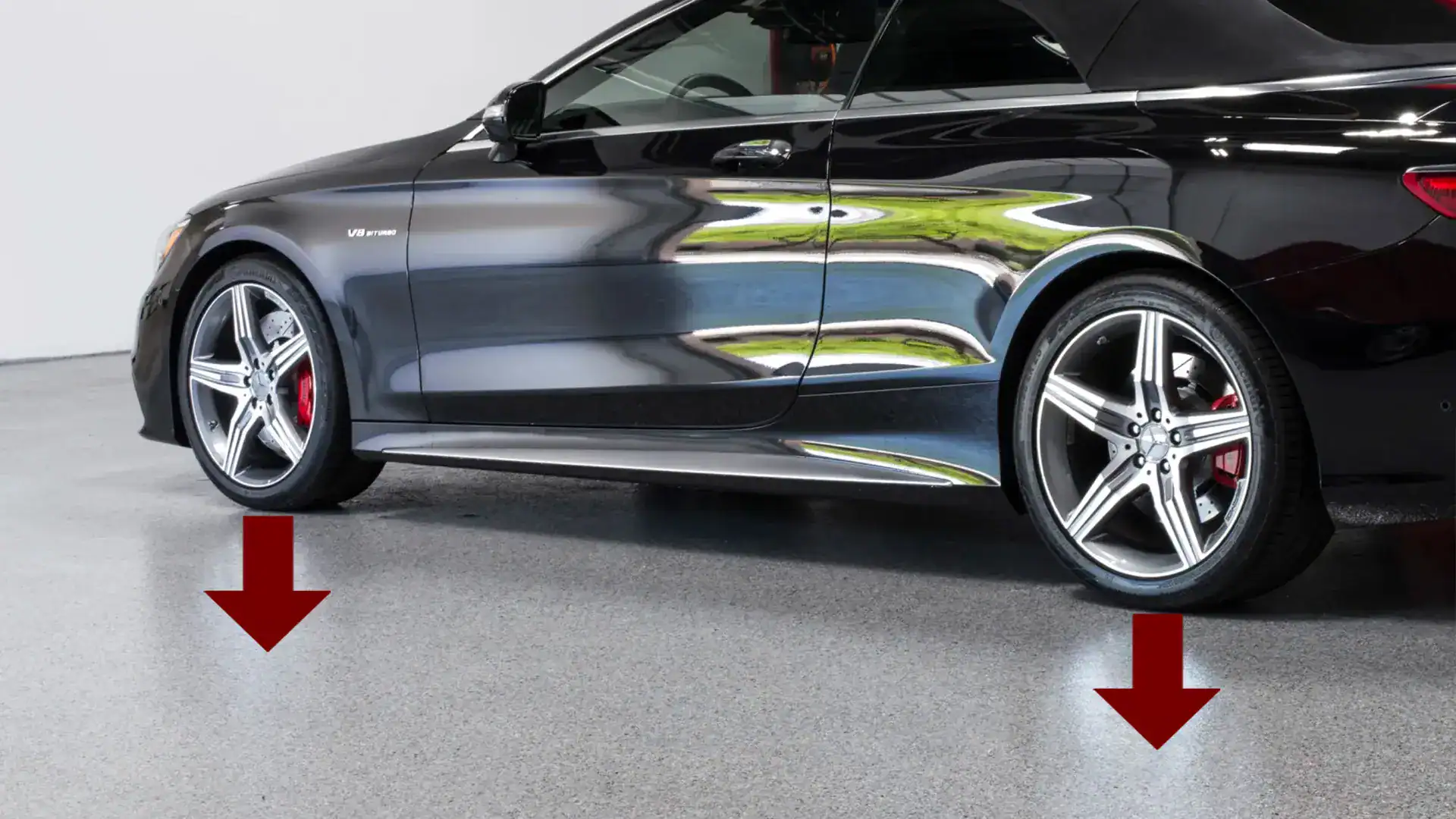
At Garage Floor Coating – The Great Lakes, we install hybrid epoxy and polyaspartic coating systems over a 2-day period. We use quality, 100%-solids coatings, layered properly, to maximize durability.
Day one of the process begins with mechanical grinding to prepare the concrete. Then, a high-build, moisture-mitigating, 100%-solids epoxy base coat is applied as the thick, moisture vapor barrier. Into this primer coat, we broadcast the customer-selected flake blend in a full-flake broadcast. The added flakes embed into the base layer adding strength and texture.
On Day two, we apply two separate layers of our 3:2 ratio, high cross-linking, 100%-solids polyaspartic, creating a tough, UV-stable surface that resists heat, pressure, chemical exposure…and yes, hot tire transfer.
Built for Real-World Conditions
High-quality polyaspartic flooring prevents hot tire pickup, resists staining, and holds up under daily wear.
In the Toledo area, where seasonal shifts and heavy use are common, that level of protection makes a lasting difference.
If your coating cannot handle what your tires bring with them, it will not last.
Contact Garage Floor Coating – The Great Lakes today to learn more about a polyaspartic floor coating system designed to stop hot tire transfer before it starts.